|
The Idea of a Social Contract |
|
|
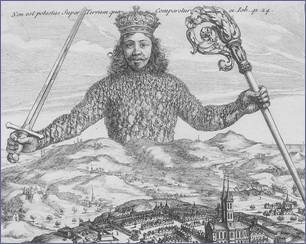
Thomas Hobbes: Leviathan (1651) Life in the State of Nature “Solitary, poor, nasty, brutish and short” War of all against all Why? a. Radical freedom b. Psychological egoism c. Equality of needs d. Equality of abilities e. Scarcity |
|
|
The Three Laws of Nature: The
passions that incline men to peace, are fear of death; desire of such things
as are necessary to commodious living; and a hope by their industry to obtain
them. And reason suggesth convenient articles of peace, upon which men may be
drawn to agreement. These articles, are they, which otherwise are called the
Laws of Nature. How to escaping the State of Nature? Create a Sovereign a. Rules (minimally, “Don’t harm one another”) + b. Enforcement mechanism |
|
|
The
Prisoner’s Dilemma |
|
|
You and Bob are arrested. Each of you is offered a deal to testify against
the other for a reduced sentence. The deal: You confess & Bob confesses: 5 years You
confess
& Bob remain silent: 0 years
You
remain silent & Bob confesses:
20 years
You & Bob both remain
silent: 1 year The point: Individually pursue best interests → 3rd
best option Trust the other prisoner → 2nd
option |
|
|
Morality as a solution to a Prisoner’s
Dilemma-type Problem: Morality
consists in the set of rules, governing how people are to treat one another,
that rational people will agree to accept, for their mutual benefit, on the
condition that others follow those rules as well. Some Advantages of the Social Contract Theory of
Morals
The Problem of Civil Disobedience Difficulties for the Theory
|
|
