CHAPTER 2 Strategy
Strategy should describe how firm intends to provide value to customers and shareholders. It is a high level, general plan that requires tactical and operational plans to make it “reality” and not just wishes on paper.
Usually addresses things like operational effectiveness, customer management, product innovation and more.
Who are our customers and what do they want (now and in the future)?
What kind of system (processes implied) do we need to give the customers what they want?
How will we anticipate and accommodate changing customer needs and subsequent changes
in products, processes and systems?
What about the competition?
STRATEGIC, TACTICAL AND OPERATIONAL PLANNING AND CONTROL IN O/M
Strategic
What kind of operation (retailer, wholesaler, manufacturer)?
How will we make/provide the product?
What kind of facilities will we need, how many, how big, etc.?
Where must facilities be located? Online presence? Mobile operations?
What kind and how much capacity do we need (LR strategic)?
How will we compete? (price, quality, flexibility, dependability, speed, other)
How are we doing? (follow up for control)
Tactical
What resources do we need to meet strategic goals?
What resources do we have to apply toward those ends?
How will we make adjustments to bridge any gaps?
What will be our priorities in allocating resources?
How are we doing? (follow up for control)
Operational
What exactly needs to be done?
How do we schedule the work to be done (loading, sequencing)?
Do we have what we need to get the work done? When do we need it? When do we
schedule delivery?
What must we do to get the work done efficiently?
Who exactly does what, when, where, how and with what?
How are we doing? (follow up for control)
The DRIVER in Strategic Planning -->THE SEARCH FOR WAYS TO ACHIEVE, COMBAT, OR MAINTAIN COMPETITIVE ADVANTAGE.
BASES FOR COMPETITION (HOW WILL WE COMPETE?)
Price/Cost
Quality
Design quality vs consistent quality
Product quality vs reliability
Conformance quality
Flexibility
Product Flexibility
Volume Flexibility
Speed
Delivery speed
Time to Market
Reconfiguration speed
Dependability
On time delivery
Product reliability
Other Product/Service Specific Criteria
Technical liaison and support
Meeting launch date
Supplier after sale support
Whatever else!
The concept of tradeoffs!
Order Winners and Order Qualifiers
Order qualifier gets you considered
Order winners gets the business
HOW DOES IT ALL FIT TOGETHER?
Activity-system maps can help within a company! (see book)
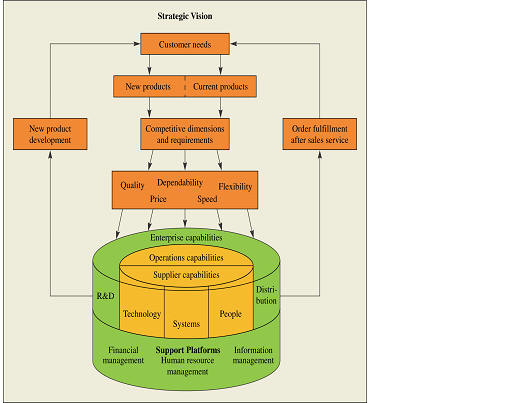
The Operations and Supply Chain Strategy Framework
PRODUCTIVITY
Productivity = outputs / inputs
Flipside of efficiency which is inputs / outputs, so increased productivity means
greater efficiency.
Partial, multifactor and total factor productivity differ in their focus.
Partial==example: labor productivity.
Multifactor==example: labor and materials combined and related to output in
units or dollars.
Total Factor==example: combine value of all inputs (usually $ value) and relate to
total Sales Revenue.
Productivity is a relative measure and useful only in some context.
Example 1 : this year’s productivity compared to last year’s performance.
Example 2 : productivity compared to some goal set for productivity during
some time frame.
Example 3 : productivity of XCompany compared to YCompany (compare companies,
divisions, and even countries).